

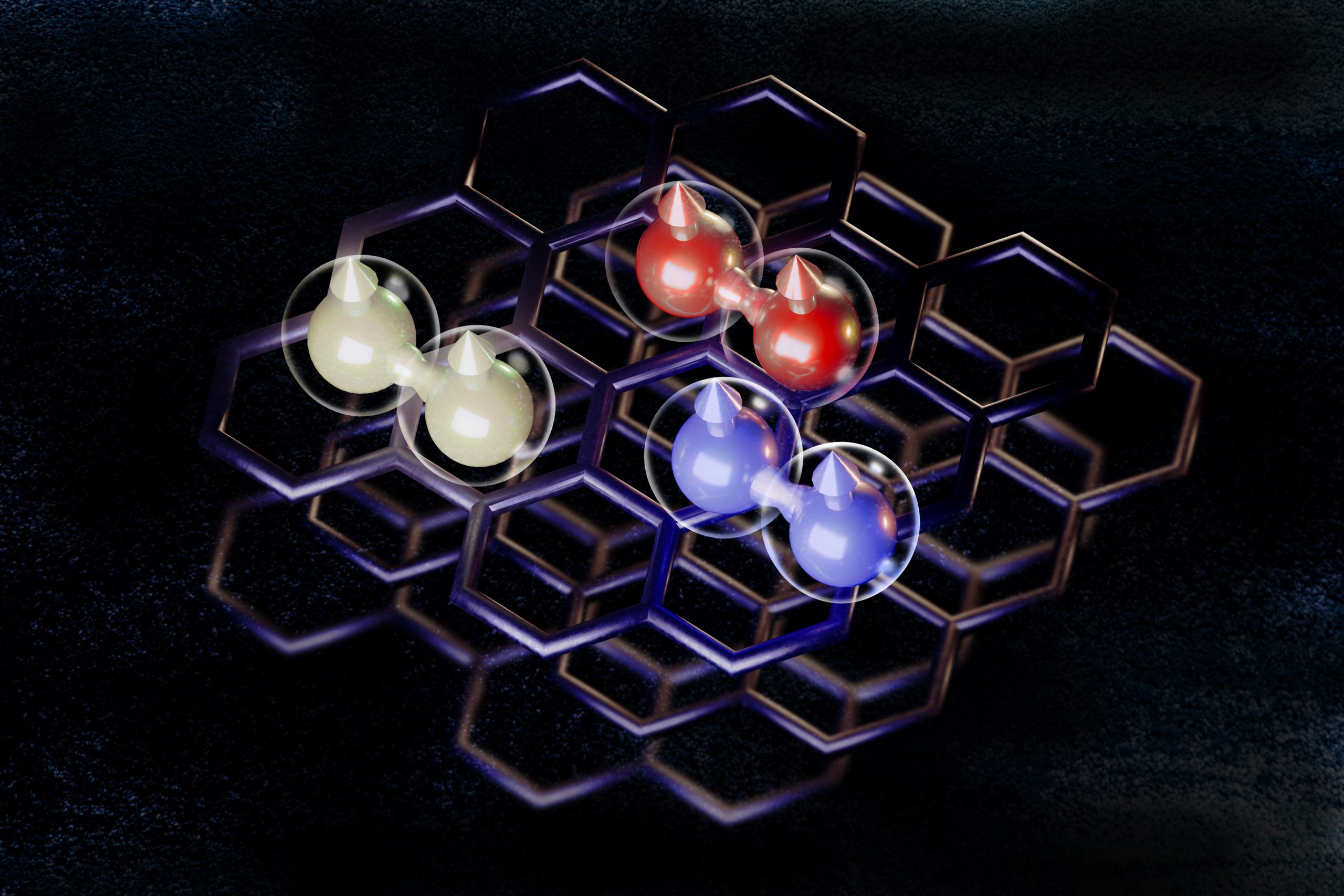
Artwork by Amy Pan, RLE
Junseok Seo, Armel A. Cotten, Shenyong Ye, Mingchi Xu, Omid Sharifi Sedeh, Henok Weldeyesus, Tonghang Han, Zhengguang Lu, Zhenghan Wu, Wei Xu, Jixiang Yang, Emily Aitken, Prayoga P. Liong, Phatthanon Pattanakanvijit, Zach Hadjri, Rasul Gazizulin, Kenji Watanabe, Takashi Taniguchi, Mingda Li, Dominik M. Zumbühl, Long Ju
https://doi.org/10.1038/s41586-026–10815‑x
Abstract:
In some unconventional superconductors, time-reversal symmetry can be broken in addition to the gauge symmetry1, resulting in superconductivities that can be enhanced or induced by magnetic fields2. However, field-enhanced superconductors are more vulnerable to impurities than Bardeen-Cooper-Schrieffer counterparts3. Crystalline rhombohedral multilayer graphene is a promising platform to explore them due to its superior material quality and gate-tunable strong correlation effects4,5. Here we report transport measurements of rhombohedral tetralayer and pentalayer graphene, demonstrating a spectrum of clean-limit superconductivities. We found three different types of field-enhanced and field-induced superconductivities in the pentalayer. They are all robust against an in-plane field up to 8.5 Tesla, exceeding the Pauli limit by tens of times. Compared to Bernal bilayer graphene showing only in-plane field-enhancement6, pentalayer graphene features superconductors enhanced by out-of-plane as well as in-plane fields. They also reside at much lower gate electric fields owing to the intrinsically flatter band dispersion—facilitating their study and further engineering. Additionally, we observed that proximitized spin-orbit coupling (SOC) generates multiple new superconductors without introducing additional disorder effects. Our work establishes a new family of magnetic field-boosted superconductors in rhombohedral graphene. Utilizing the high accessibility with moderate gate voltages, this will pave the way for realizing non-Abelian quasiparticles through interfacial engineering7 in the extreme clean limit, in that proximitized SOC leads to topological states8 and maintains the ultrahigh quality of crystalline graphene.
Researchers in their laboratory at MIT, from left to right, graduate students Shenyong Ye and Junseok Seo, and Associate Professor Long Ju. Photograph by Sampson Wilcox, RLE.